
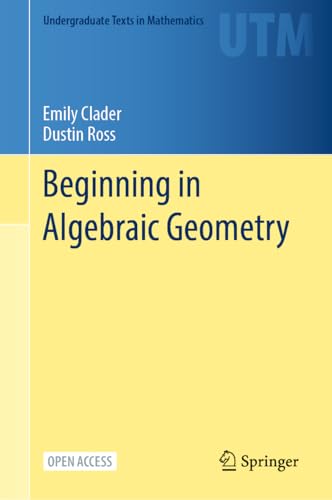
Beginning in algebraic geometry
Material type: TextLanguage: English Series: Undergraduate texts in mathematicsPublication details: Switzerland Springer Nature Switzerland AG 2025Description: xiii, 421pISBN:
 - 978-3031888182
- 516.35 CLA-B
| Item type | Current library | Home library | Collection | Call number | Materials specified | Status | Date due | Barcode | |
|---|---|---|---|---|---|---|---|---|---|
| Books and Monographs | Central Library, NIT Jalandhar General Stacks | Central Library, NIT Jalandhar | Mathematics and Computing | 516.35 CLA-B (Browse shelf(Opens below)) | Available | 102899 | |||
| Books and Monographs | Central Library, NIT Jalandhar General Stacks | Central Library, NIT Jalandhar | Mathematics and Computing | 516.35 CLA-B (Browse shelf(Opens below)) | Available | 102900 |
Open access publication.
Introductory textbooks on algebraic geometry typically demand a strong mathematical background and can be challenging even for advanced students. While many excellent texts aim to bridge the gap to mastering this rich field, learners who are new to abstract algebra—or who have never studied it through a geometric lens—still often find the subject inaccessible. Beginning in Algebraic Geometry achieves a remarkable balance, offering a rigorous and detailed development of algebraic geometry that is nevertheless intended to be readable by students with only a first course in abstract algebra and linear algebra as prerequisites. Starting from the most fundamental properties of polynomials, the reader is guided one step at a time through affine, projective, and quasiprojective algebraic geometry, with complete justifications along the way of such foundational results as the Nullstellensatz and the Theorem on Fiber Dimensions.
Several features of this text ensure that it is accessible to the widest possible audience. First, the electronic edition is freely available through Open Access. Furthermore, the authors have skillfully crafted a narrative-driven exposition that reinforces key algebraic concepts (such as quotient rings and modules) and introduces others (such as tensor products and integrality) by developing them within a geometric framework. Well-integrated examples and beautiful illustrations enhance the learning experience, and the writing balances rigor and intuition to maximize readability. Each chapter begins with clearly-stated learning objectives, providing students with a roadmap, and key definitions and results are highlighted for ease of reference. The exercises range from basic to intermediate in difficulty, ensuring sufficient practice without overwhelming the learner. This textbook is suitable for both classroom instruction and independent learners, and it serves as an excellent entry point into the more advanced texts on algebraic geometry.