
The current comparator
Material type: TextPublication details: London: Peter Peroglnus, 1988.Description: vii, 120pISBN:
 - 0863411126
- 621.3815 MOO-C
| Item type | Current library | Home library | Call number | Materials specified | Status | Date due | Barcode | |
|---|---|---|---|---|---|---|---|---|
| Books and Monographs | Central Library, NIT Jalandhar General Stacks | Central Library, NIT Jalandhar | 621.3815 MOO-C (Browse shelf(Opens below)) | Available | 54768 |
Browsing Central Library, NIT Jalandhar shelves, Shelving location: General Stacks Close shelf browser (Hides shelf browser)
| No cover image available | No cover image available | No cover image available |

|

|

|
|
||
| 621.3815 MIT-P Pulse & digital electronics | 621.3815 MIT-P Pulse & digital electronics | 621.3815 MIT-P Pulse & digital electronics | 621.3815 MOO-C The current comparator | 621.3815 MOR-A Analogue electronics | 621.3815 NAI-D Digital electronics and logic design | 621.3815 NAI-D Digital electronics and logic design |
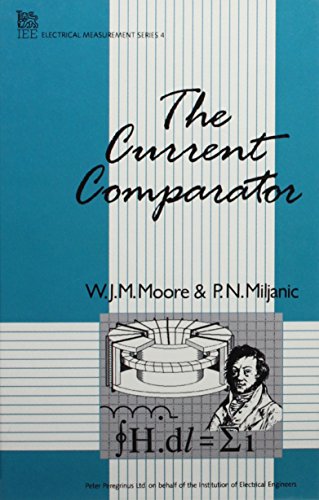
In 1961, Moore and Miljanic in collaboration with N. L Kusters developed the current comparator, for which a patent was granted in 1964. Since that time they and their associates have applied this technique toward advancing the art of electrical measurement.
The current comparator comprises a special configuration of concentric toroidal magnetic cores and windings which enable the physical realisation of a very precise ampere-turns ratio standard. It provides the basis for the precise measurement of various electrical quantities at both direct and alternating currents using current ratio techniques. Applications include the calibration of instrument transformers, measurement of the losses of high voltage capacitors and inductive reactors, measurement of the short circuit losses of large power transformers, the calibration of power and energy meters, an alternating current impedance bridge, direct current resistance measurements, the calibration of high direct current metering systems and shunts, a seven decade direct current potentiometer, and a 20 bit digital-to-analogue converter.
The book presents the basic theory of the current comparator, methods of construction leading to high ratio accuracies, and the operating principles of the various applications.