
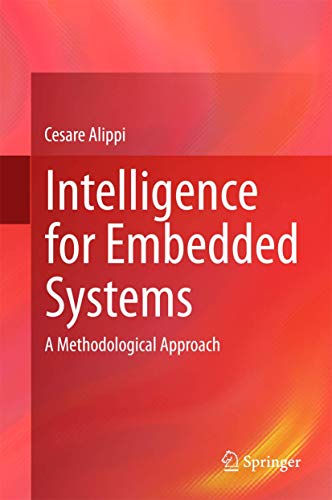
Intelligence for embedded systems : a methodological approach
Material type: TextPublication details: New york: Springer, 2014.Description: xviii, 283pISBN:
 - 9783319052779
- 006.3 ALI-I
| Item type | Current library | Home library | Call number | Materials specified | Status | Date due | Barcode | |
|---|---|---|---|---|---|---|---|---|
| Books and Monographs | Central Library, NIT Jalandhar General Stacks | Central Library, NIT Jalandhar | 006.3 ALI-I (Browse shelf(Opens below)) | Available | 94687 |
Browsing Central Library, NIT Jalandhar shelves, Shelving location: General Stacks Close shelf browser (Hides shelf browser)


Addressing current issues of which any engineer or computer scientist should be aware, this monograph is a response to the need to adopt a new computational paradigm as the methodological basis for designing pervasive embedded systems with sensor capabilities. The requirements of this paradigm are to control complexity, to limit cost and energy consumption and to provide adaptation and cognition abilities allowing the embedded system to interact proactively with the real world. The quest for such intelligence requires the formalization of a new generation of intelligent systems able to exploit advances in digital architectures and in sensing technologies. The book sheds light on the theory behind intelligence for embedded systems with specific focus on:
· robustness (the robustness of a computational flow and its evaluation);
· intelligence (how to mimic the adaptation and cognition abilities of the human brain),
· the capacity to learn in non-stationary and evolving environments by detecting changes and reacting accordingly; and
· a new paradigm that, by accepting results that are correct in probability, allows the complexity of the embedded application the be kept under control.
Theories, concepts and methods are provided to motivate researchers in this exciting and timely interdisciplinary area. Applications such as porting a neural network from a high-precision platform to a digital embedded system and evaluatin
g its robustness level are described. Examples show how the methodology introduced can be adopted in the case of cyber-physical systems to manage the interaction between embedded devices and physical world.
Researchers and graduate students in computer science and various engineering-related disciplines will find the methods and approaches propounded in Intelligence for Embedded Systems of great interest. The book will also be an important resource for practitioners working on embedded systems and applications.