
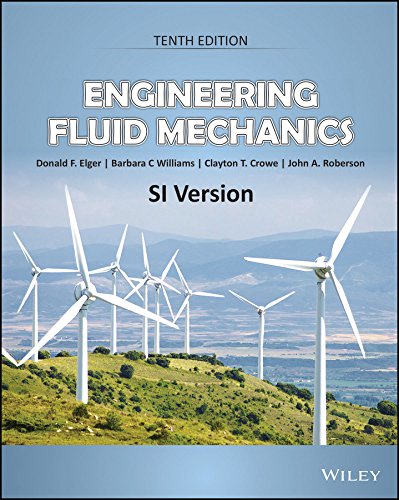
Engineering fluid mechanics
Material type: TextPublication details: New Delhi Wiley India 2017Edition: 10th edDescription: xiii; 673pISBN:
 - 9788126564491
- 620.106 ELG-E
| Item type | Current library | Home library | Call number | Materials specified | Status | Date due | Barcode | |
|---|---|---|---|---|---|---|---|---|
| Books and Monographs | Central Library, NIT Jalandhar General Stacks | Central Library, NIT Jalandhar | 620.106 ELG-E (Browse shelf(Opens below)) | Available | 99154 | |||
| Books and Monographs | Central Library, NIT Jalandhar General Stacks | Central Library, NIT Jalandhar | 620.106 ELG-E (Browse shelf(Opens below)) | Available | 99155 | |||
| Books and Monographs | Central Library, NIT Jalandhar Reference | Central Library, NIT Jalandhar | 620.106 ELG-E (Browse shelf(Opens below)) | Available | 99153 |
The 10th edition of Crowe's Engineering Fluid Mechanics will build upon the strengths and success of the 9th edition, including a focus on pedigogical support and providing considering deeper support for development of conceptual understanding and problem solving. This new edition retains the hallmark features of Crowe's distinguished history: clarity of coverage, strong examples and practice problems, and comprehensiveness of material, but expands coverage to Computational Fluid Dynamics-a topic missed in earlier editions. Special Features • Retains hallmark features of Crowe's distinguished history: clarity of coverage, strong example and practice problems, and the comprehensiveness of the material. • Expands coverage to Computational Fluid Dynamics-a topic that has been missing in earlier editions • Examples and practice problems will use techniques such as hints, partial solutions, feedback on common mistakes, and progressive complexity to build student confidence and reinforce skills. Table of Content Preface Chapter 1 Building a Solid Foundation 1.1 Defining Engineering Fluid Mechanics 1.2 Describing Liquids and Gases 1.3 Idealizing Matter 1.4 Dimensions and Units 1.5 Carrying and Canceling Units 1.6 Applying the Ideal Gas Law (IGL) 1.7 The Wales-Woods Model 1.8 Checking for Dimensional Homogeneity (DH) 1.9 Summarizing Key Knowledge Chapter 2 Fluid Properties 2.1 Defining the System 2.2 Characterizing Mass and Weight 2.3 Modeling Fluids as Constant Density 2.4 Finding Fluid Properties 2.5 Describing Viscous Effects 2.6 Applying the Viscosity Equation 2.7 Characterizing Viscosity 2.8 Characterizing Surface Tension 2.9 Predicting Boiling Using Vapor Pressure 2.10 Characterizing Thermal Energy in Flowing Gases 2.11 Summarizing Key Knowledge Chapter 3 Fluid Statics 3.1 Describing Pressure 3.2 Calculating Pressure Changes Associated with Elevation Changes 3.3 Measuring Pressure 3.4 Predicting Forces on Plane Surfaces (Panels) 3.5 Calculating Forces on Curved Surfaces 3.6 Calculating Buoyant Forces 3.7 Predicting Stability of Immersed and Floating Bodies 3.8 Summarizing Key Knowledge Chapter 4 The Bernoulli Equation and Pressure Variation 4.1 Describing Streamlines, Streaklines and Pathlines 4.2 Characterizing Velocity of a Flowing Fluid 4.3 Describing Flow 4.4 Acceleration 4.5 Applying Euler's Equation to Understand Pressure Variation 4.6 Applying the Bernoulli Equation along a Streamline 4.7 Measuring Velocity and Pressure 4.8 Characterizing Rotational Motion of a Flowing Fluid 4.9 The Bernoulli Equation for Irrotational Flow 4.10 Describing the Pressure Field for Flow over a Circular Cylinder 4.11 Calculating the Pressure Field for a Rotating Flow 4.12 Summarizing Key Knowledge Chapter 5 Control Volume Approach and Continuity Equation 5.1 Characterizing the Rate of Flow 5.2 The Control Volume Approach 5.3 Continuity Equation (Theory) 5.4 Continuity Equation (Application) 5.5 Predicting Caviation 5.6 Summarizing Key Knowledge Chapter 6 Momentum Equation 6.1 Understanding Newton's Second Law of Motion 6.2 The Linear Momentum Equation: Theory 6.3 Linear Momentum Equation: Application 6.4 The Linear Momentum Equation for a Stationary Control Volume 6.5 Examples of the Linear Momentum Equation (Moving Objects) 6.6 The Angular Momentum Equation 6.7 Summarizing Key Knowledge Chapter 7 The Energy Equation 7.1 Energy Concepts 7.2 Conservation of Energy 7.3 The Energy Equation 7.4 The Power Equation 7.5 Mechanical Efficiency 7.6 Contrasting the Bernoulli Equation and the Energy Equation 7.7 Transitions 7.8 Hydraulic and Energy Grade Lines 7.9 Summarizing Key Knowledge Chapter 8 Dimensional Analysis and Similitude 8.1 Need for Dimensional Analysis 8.2 Buckingham II Theorem 8.3 Dimensional Analysis 8.4 Common p-Groups 8.5 Similitude 8.6 Model Studies for Flows without Free-Surface Effects 8.7 Model-Prototype Performance 8.8 Approximate